
Many US-based traders assume that “logging in” to a major exchange is a trivial step: enter credentials, 2FA, trade. That assumption hides several distinct mechanisms and trade-offs specific to OKX’s combined CEX/Web3 architecture. In practice, the login process sits at an intersection of centralized controls (KYC, custody, platform-level risk controls) and decentralized touchpoints (non-custodial wallets, hardware key integrations). Understanding how those pieces work — and where they fail — changes how you manage accounts, keys, and operational security.
This piece corrects common misconceptions and gives traders a reusable mental model: treat OKX as two linked systems — a custody-controlled exchange account and a parallel Web3 wallet environment — each with different trust boundaries, recovery paths, and attack surfaces. I’ll explain the mechanisms, the practical trade-offs (convenience vs. control, liquidity vs. custody), what recent platform moves imply, and decision heuristics you can reuse when you log in, trade spot, or interact with Web3 from the same vendor.
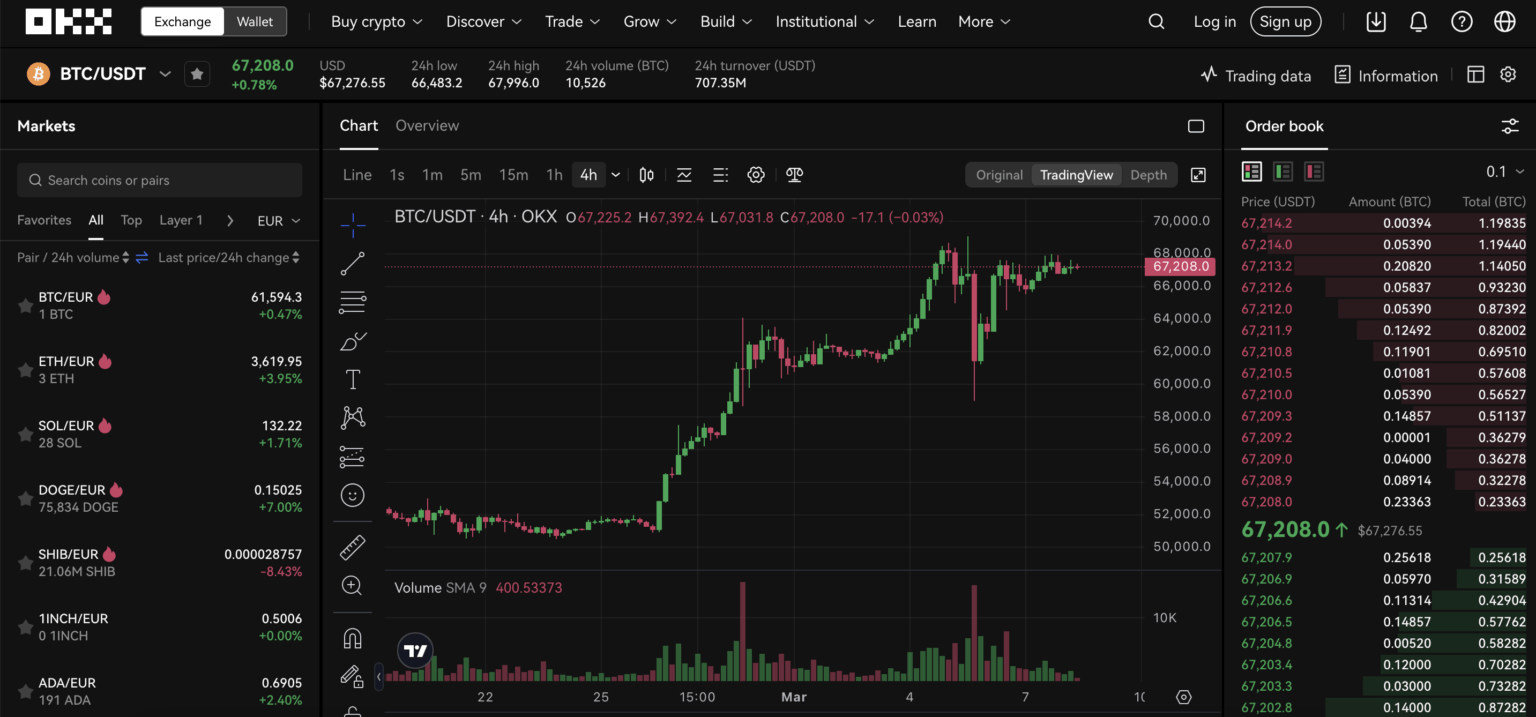
How OKX Login Actually Works: Two Systems, One Interface
At a mechanisms level, there are two distinct login / access modes you should treat separately: (1) your centralized OKX exchange account, secured by KYC, password, and mandatory 2FA; and (2) your OKX Web3 (non-custodial) wallet, which uses seed phrases and optional hardware wallets. The exchange account is subject to AML/KYC procedures — meaning recovery relies on identity checks and the platform’s customer processes. The Web3 wallet is self-custodial: if you lose the seed phrase, OKX cannot restore it for you. Conflating these two as the “same” access path is a frequent source of permanent loss.
Login protections on the exchange side combine military-grade encryption, AI-driven threat detection, and multi-factor authentication (SMS, TOTP, biometrics). Those systems detect logins that look anomalous and can enforce additional verification. That reduces remote compromise risk but introduces operational friction: flagged logins can block trading during fast markets. For traders who need guaranteed execution speed during volatile moves, understand that security checks can sometimes delay access — a small but meaningful trade-off.
Spot Trading on OKX: Mechanisms, Strengths, and Where It Breaks
Spot trading on OKX is straightforward in principle — buy or sell at current market prices — but the practical behavior depends on liquidity, order type, and cross-platform features. OKX supports more than 300 assets and provides advanced TradingView charting in the web UI; that makes technical execution and monitoring easier for active traders. However, liquidity varies. The exchange delists pairs periodically — for example, a recent batch removal of several smaller tokens underscores that low-volume listings are not guaranteed. Delisting is routine risk management, but for traders holding niche tokens it can force conversion at unfavorable prices or require moving assets off-exchange before a deadline.
Three operational points matter when you log in to trade spot:
1) Slippage and order type: Market orders are simple but vulnerable in thin books. Use limit orders or partial fills when liquidity is uncertain. 2) Cross-margin vs. isolated margin: Spot and margin modes differ. Margin amplifies gains and losses; OKX offers up to 10x on margin trades, which requires strict position sizing and stop discipline. 3) Withdrawal and custody: Funds held in the CEX are covered by Proof of Reserves and are largely stored in air-gapped cold wallets, but withdrawals still require off-chain approvals and KYC checks — meaning quick exit during a systemic event may be slower than a wallet-to-wallet transfer.
Web3 on OKX: When Convenience Becomes a Different Risk Profile
OKX’s Web3 features — a non-custodial wallet, browser extension, DEX aggregator, and support for 130+ blockchains — promise unified access to DeFi and cross-chain swaps. Mechanically, the browser extension and wallet sign transactions locally with your seed or hardware key; they do not rely on exchange-side custody. That separation is powerful: you can interact with apps without depositing funds on the exchange. But it also creates a cognitive burden: the same brand and interface host two different trust models.
Phishing remains the primary external risk for Web3 workflows. Attackers mimic login pages or prompt signature approvals that look routine but authorize token approvals or transfer rights. Unlike the exchange account, a compromised seed phrase typically cannot be reversed. That asymmetry matters when deciding where to hold long-term assets versus short-term trading capital.
Myth-Busting: Five Misconceptions Traders Often Hold
1) Myth: “If the exchange is big, I don’t need my own security practices.” Reality: Exchanges reduce some risks but introduce custodial counterparty risk and have different recovery processes. Keep significant long-term holdings in self-custody or diversified custodial arrangements.
2) Myth: “KYC makes account recovery easy.” Reality: KYC helps but recovery can still be slow, and facial recognition or ID checks are not foolproof; document quality and regional compliance differences matter.
3) Myth: “Web3 wallet on the same platform is as safe as exchange funds.” Reality: Non-custodial wallets shift responsibility: OKX cannot restore lost seeds. Treat them as a separate asset class requiring backup.
4) Myth: “Proof of Reserves equals absolute safety.” Reality: PoR shows backing at a point in time and increases transparency, but it doesn’t eliminate behavioral, operational, or governance risks.
5) Myth: “Delisting won’t affect me.” Reality: If you hold delisted pairs, you may face narrow markets and wider spreads that increase execution cost or force off-exchange transfers under time pressure.
Decision Heuristics: A Practical Framework for Logging In and Trading
Use this three-step heuristic whenever you access OKX: classify, minimize, segregate. Classify whether the activity is CEX (spot/margin/futures) or Web3 (wallet/DApp). Minimize the on-exchange balance to the amount you intend to trade within your time horizon. Segregate accounts and keys: keep a distinct Web3 wallet for DApp interactions and use hardware wallets for large positions where feasible.
A concrete habit: before executing a large spot order, confirm liquidity in the orderbook, set a limit price or use iceberg-style execution, and ensure 2FA devices are accessible. Before signing any Web3 transaction, disconnect your exchange session and verify the contract and exact permissions requested in the signature modal.
What to Watch Next (Near-Term Signals)
Watch delisting announcements and token listings closely — OKX has recently removed several low-volume pairs, which signals ongoing liquidity maintenance and delisting risk for fringe tokens. Monitor Proof of Reserves disclosures for transparency trends, and keep an eye on regulatory developments in the US: changes to KYC/AML interpretations could alter onboarding friction and withdrawal policies. Finally, watch how exchanges integrate hardware wallet support and advanced login flows; incremental UX improvements can materially reduce phishing success rates.
FAQ
Do I need KYC to use OKX from the US?
Yes. OKX requires Know Your Customer verification for account creation and to comply with AML rules. That process involves government-issued ID and a facial recognition liveness check. KYC enables higher withdrawal limits and margin/derivatives access but also links your identity to on-platform activity.
Should I keep my long-term crypto on my OKX account?
Not as a general rule. For long-term holdings prioritize self-custody with hardware wallets or reputable institutional custody if you need custody services. Keep only the operational capital required for active spot or margin trading on the exchange; this balances convenience with counterparty and operational risk.
How do I safely use both OKX’s exchange and Web3 wallet?
Treat them separately: use the exchange for fast spot execution and margin needs; use the Web3 wallet for DApp interactions and DeFi exposure with strict seed management and hardware key protections. Always verify URLs and use browser extension hygiene to reduce phishing risk. For login help, OKX provides a dedicated sign-in flow; you can start at the platform’s official login page like this: okx login.
What should I do if a token I hold is delisted?
Act early. Delisting notices usually include a withdrawal window. Move assets to a self-custodial wallet or another venue before the deadline. If liquidity is poor, consider splitting the withdrawal into smaller chunks or using OTC channels for large positions to avoid severe price impact.
Bottom line: logging into OKX is not a single, uniform act. It’s a decision node that exposes different risk and recovery regimes depending on whether you operate on the centralized exchange or in the Web3 wallet. Treat each path explicitly, adopt distinct security habits, and plan for the platform’s operational realities — delistings, liquidity shifts, and identity-based recovery processes — rather than assuming a one-size-fits-all login will cover every contingency.
